
Preventable diseases sound simple, right? If they can be prevented, why do they still affect millions of people every year—especially in rural and low-income communities?
The answer is not always a lack of medicines or hospitals. Very often, it’s a lack of awareness. People fall sick not because help doesn’t exist, but because they don’t know when, how, or why to seek it.
This is where Health Awareness Programs play a life-changing role. At Gramonnati Seva Pratishthan, we see every day how the right information, shared at the right time, can protect families and build healthier communities.
Understanding Preventable Diseases
Preventable diseases are illnesses that can be avoided through simple actions like hygiene, vaccination, safe food, clean water, and early medical care.
In rural and low-income areas, common examples include diarrhea, malaria, dengue, tuberculosis, anemia, and respiratory infections. These aren’t rare or complicated diseases—but they can become deadly if ignored.
Something as basic as washing hands, using clean drinking water, or visiting a health center early can stop an illness before it grows. Small habits often make the biggest difference.
What Are Health Awareness Programs?
Health awareness programs aim to educate people about staying healthy and preventing illness before it strikes.
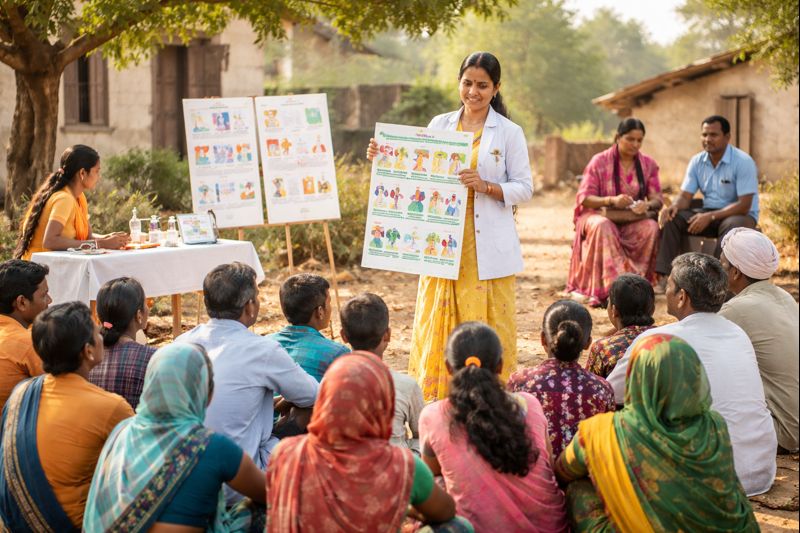
These programs take many forms—village workshops, health camps, street plays, door-to-door counseling, school sessions, and community meetings. They don’t rely on big medical terms, but on simple, practical guidance.
NGOs like Gramonnati Seva Pratishthan and local health workers act as bridges between communities and healthcare systems. They speak the local language, understand local challenges, and earn people’s trust.
The Link Between Awareness and Disease Prevention
When people understand how diseases spread, their behavior naturally changes. Knowledge leads to action.
Awareness encourages early diagnosis. A cough is no longer “just a cough” when people know it could be tuberculosis. Fever is taken seriously when families understand the risks.
Health Awareness Programs also promote daily practices like cleanliness, balanced diets, and vaccination. Think of it as giving people a health manual for everyday life—no doctor’s degree required.
Key Areas Addressed by Health Awareness Programs
Most awareness initiatives focus on areas that have the biggest impact:
- Personal hygiene and sanitation: Handwashing, toilet use, waste disposal
- Safe drinking water: Boiling, filtering, and storing water safely
- Nutrition: Balanced diets, child feeding practices, anemia prevention
- Immunization and maternal health: Vaccines, antenatal care, safe deliveries
- Communicable diseases: How infections spread and how to stop them
These topics may sound basic, but they save lives every single day.
Role of Community Participation
Health programs work best when communities take ownership.
Local participation builds trust. When a neighbor explains why vaccination matters, people listen more closely than they might to an outsider.
Training community health volunteers creates local champions of change. Over time, healthy habits become normal routines—not forced instructions. That’s how real, long-term change happens.
Impact of Health Awareness Programs
The results are powerful and visible.
Communities report fewer disease outbreaks. Families seek treatment earlier instead of waiting until it’s too late. Children miss fewer school days due to illness.
Over time, healthier families mean stronger livelihoods, better education outcomes, and reduced healthcare costs. Prevention, after all, is cheaper—and kinder—than cure.
Challenges in Implementing Awareness Programs
Of course, the journey isn’t always smooth.
Low literacy makes written information ineffective. Misinformation spreads fast—sometimes faster than facts. Deep-rooted beliefs can create resistance to new practices.
Geographical isolation and limited resources also make consistent outreach difficult, especially in remote villages.
Overcoming These Challenges
The solution lies in simplicity and collaboration.
Using local languages, visuals, stories, and live demonstrations makes messages easy to understand. A short skit can sometimes teach more than a long lecture.
Partnering with schools, anganwadis, ASHA workers, and village leaders strengthens outreach. When everyone works together, awareness turns into action.
Conclusion
Preventable diseases should never cost lives. Yet, they do—mainly because people lack the right information at the right time.
Health Awareness Programs empower communities with knowledge, confidence, and control over their own health. They turn fear into understanding and habits into protection.
At Gramonnati Seva Pratishthan, we believe health awareness is not a one-time activity—it’s a continuous movement. With community support and participation, we can build a future where prevention comes first and illness takes a back seat.
Because a healthy community isn’t built in hospitals alone—it starts with awareness, right at home.